AI strategy isn’t about chasing shiny tools—it’s about making smart, deliberate moves that create real business value today and position you for what’s next. The companies winning with AI aren’t waiting for “perfect conditions.” They’re acting now while laying the groundwork for the future.
Here are five AI strategies you can implement immediately, followed by five AI initiatives you should start developing for 2026.
5 AI Strategies You Can Implement Right Now
1. Automate Repetitive Internal Workflows
Start where friction already exists. AI excels at handling repetitive, rules-based tasks such as:
Document classification
Meeting summaries and action items
Data entry and validation
Basic reporting
By deploying AI copilots or workflow automation tools, teams can reclaim hours every week—often with minimal change management.
Why it matters: Fast ROI and immediate productivity gains.
2. Enhance Customer Support with AI Assistants
AI-powered chat and support assistants can now:
Handle common questions
Provide instant responses 24/7
Route complex issues to the right human agent
Draft responses for support teams
Importantly, these systems don’t replace people—they amplify them.
Why it matters: Better customer experience without scaling headcount.
3. Use AI for Content Drafting and Ideation
AI can dramatically speed up:
Blog outlines
Social media drafts
Marketing emails
Sales enablement content
Human oversight remains essential, but AI reduces blank-page syndrome and accelerates execution.
Why it matters: Faster go-to-market for marketing and communications.
4. Apply AI to Data Analysis and Insights
Many organizations sit on mountains of underused data. AI tools can:
Identify trends and anomalies
Generate natural-language insights
Support faster decision-making
You don’t need perfect data—just good enough data and the willingness to experiment.
Why it matters: Data-driven decisions without needing a data science team.
5. Upskill Teams with AI Literacy Programs
The most overlooked AI strategy is people. Start training employees on:
How AI tools work
Where AI can (and can’t) help
Responsible and ethical usage
Even lightweight training creates confidence and adoption.
Why it matters: Technology only works if people trust and use it.
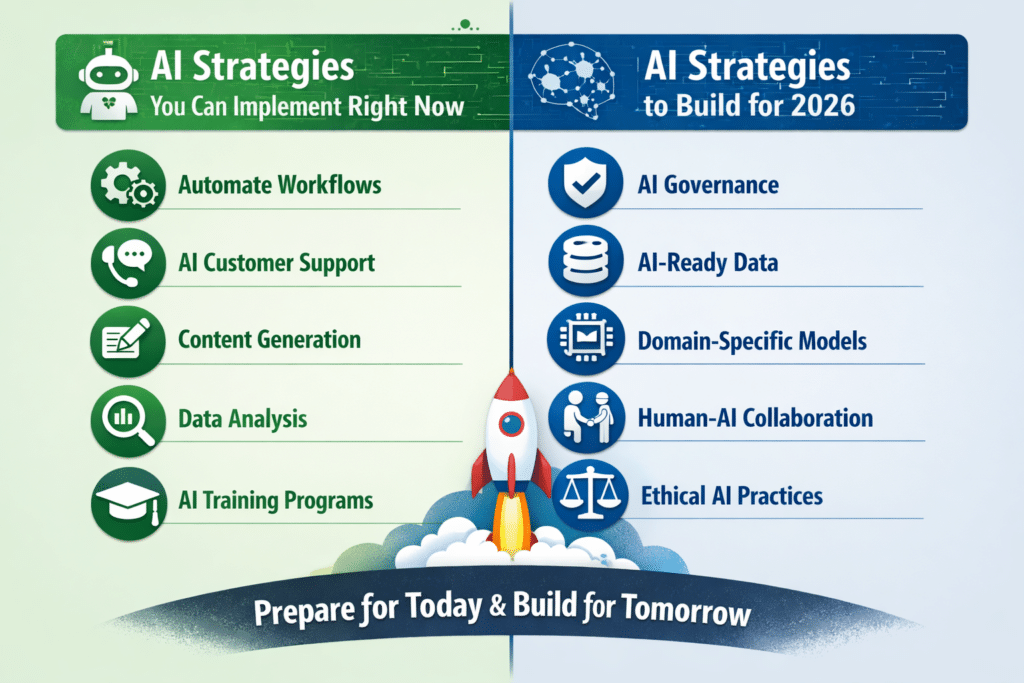
5 AI Strategies to Start Building for 2026
1. Develop a Unified AI Governance Framework
By 2026, AI governance will be non-negotiable. Forward-thinking organizations are already defining:
Data usage policies
Model accountability
Bias and risk mitigation
Human-in-the-loop standards
This isn’t about slowing innovation—it’s about enabling it safely.
Why it matters: Compliance, trust, and scalability.
2. Invest in High-Quality, AI-Ready Data Infrastructure
Future AI success depends on data quality. Start now by:
Cleaning and standardizing data
Breaking down data silos
Improving metadata and documentation
AI models are only as strong as the data behind them.
Why it matters: Strong foundations unlock advanced AI use cases later.
3. Build Domain-Specific AI Models
Generic AI tools are powerful—but domain-specific models will define competitive advantage. Consider AI trained on:
Your proprietary data
Industry-specific knowledge
Internal processes and language
These systems deliver more accurate, context-aware results.
Why it matters: Differentiation competitors can’t easily copy.
4. Design Human-AI Collaboration Models
The future of work isn’t human or AI—it’s human plus AI. Leading organizations are rethinking:
Job roles and responsibilities
Decision authority between humans and machines
New performance metrics
This requires intentional design, not improvisation.
Why it matters: Sustainable productivity gains without burnout or resistance.
5. Embed Ethical AI and Trust by Design
By 2026, customers and regulators will expect transparency. That means:
Explainable AI decisions
Clear disclosure of AI use
Ongoing monitoring for bias and harm
Trust will be a competitive advantage.
Why it matters: Long-term brand credibility and risk reduction.
Partner with Zozimus Agency
AI strategy isn’t a one-time initiative—it’s a journey. The smartest organizations are balancing quick wins today with strategic investments for tomorrow. Start small, learn fast, and build intentionally.
The future isn’t waiting—and neither should your AI strategy.