Here at Zozimus, we are always watching the digital landscape for the subtle shifts that turn into seismic changes. Search has always been one of the most powerful ways for brands to be discovered, trusted, and chosen. But the search experience we grew up with, the one where a user asks a question, scans a list of blue links, and clicks through to a website, is quickly becoming something else entirely.
Google is no longer just organizing the web. Increasingly, it is answering for the web.
That evolution has created the rise of zero-click searches, where users get what they need directly on the search results page without ever visiting another website. For marketers and business leaders, this is not a small technical SEO trend. It is a fundamental change in how people discover information, evaluate brands, and move through the customer journey.
The Zero-Click Reality Has Accelerated
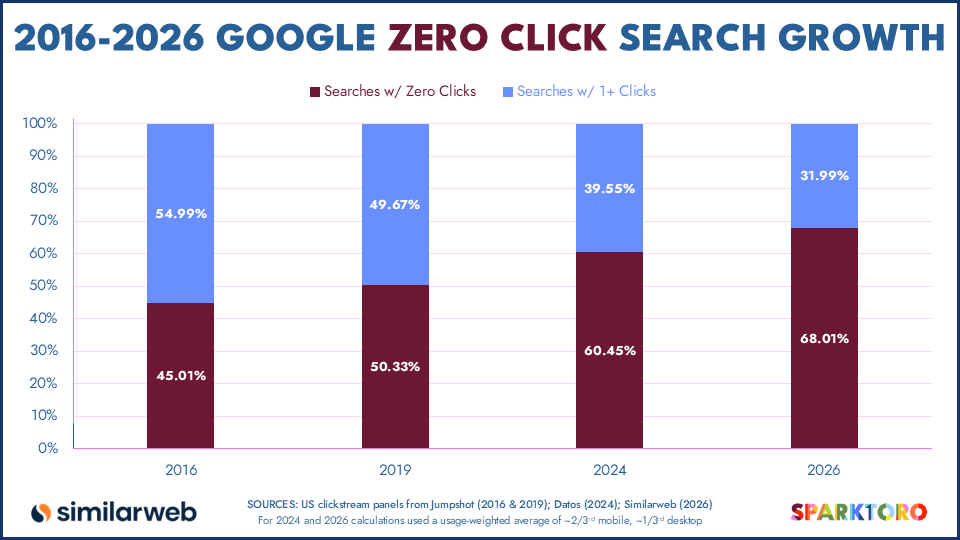
When we originally wrote about this topic, the data was already eye-opening. SparkToro’s 2024 zero-click search research found that for every 1,000 Google searches in the U.S., only 360 resulted in clicks to the open web. In other words, a majority of searches ended without a traditional organic click to another website.
Now, the picture has become even clearer.
According to SparkToro’s 2026 research, based on Similarweb desktop and mobile clickstream data from January through April 2026, 68.01% of Google searches ended without a click. That means less than one-third of Google searches are now sending users to another website.
SparkToro also notes that U.S. zero-click searches were at 60.45% in 2024, meaning clickless queries grew by 7.5 percentage points in just two years. That is one of the fastest accelerations of the zero-click trend in the last decade.
For brands, the message is clear: rankings still matter, but rankings alone no longer guarantee traffic.

What Is a Zero-Click Search?
A zero-click search happens when Google provides enough information directly on the search engine results page that the user does not need to click through to a website.
This can happen through featured snippets, knowledge panels, People Also Ask boxes, local packs, shopping results, calculators, maps, definitions, sports scores, weather cards, and now, increasingly, AI-generated answers.
The user still searches. The brand may still appear. The answer may even be influenced by content from your website. But the click never comes.
That is the strange new magic trick of modern search. Your content can do the work, shape the answer, and influence the decision, while your analytics dashboard shows less traffic than expected.
Why Zero-Click Search Is Growing
Several forces are pushing Google further into a zero-click future.
First, Google has continued to expand SERP features designed to answer questions instantly. These features are helpful for users, but they often reduce the need to visit the original source.
Second, AI Overviews have become a major part of the search experience. SparkToro points to Ahrefs data suggesting that AI Overviews now appear on more than 20% of searches and, when present, can reduce click-through rates dramatically.
Third, user behavior is changing. People increasingly expect fast answers, summarized recommendations, and frictionless discovery. Search engines, social platforms, and AI tools are all training users to consume information inside the platform where the query begins.
Finally, Google has a business incentive to keep users engaged within its own ecosystem. SparkToro’s 2026 analysis argues that Google’s evolution toward more instant answers and platform-contained experiences is unlikely to slow.
The Impact on Businesses
For years, the playbook was relatively straightforward. Rank higher, earn more clicks. Earn more clicks, generate more leads. Generate more leads, grow revenue.
That playbook is not gone, but it is incomplete.
Businesses may now see organic traffic flatten or decline even when rankings remain stable. This is especially true for companies whose SEO strategies rely heavily on top-of-funnel informational searches. A brand can still be visible in search while receiving fewer visits from search.
That distinction matters.
At Zozimus, we already see how competitive search visibility can be across valuable Boston agency terms. Zozimus has strong visibility for terms such as “boston ppc agency,” “PPC Agency Boston,” “Boston analytics agency,” and “boston brand strategy agency,” while broader terms like “digital marketing agency boston” and “boston marketing agency” remain more competitive.
This reinforces the larger point: the future of search is not simply about chasing more rankings. It is about understanding which rankings create business value, which queries influence the buying journey, and where your audience actually takes action.

SEO Is Not Dead. But the Job of SEO Has Changed.
It would be easy to look at the rise of zero-click search and conclude that SEO is losing its value. We believe the opposite is true.
SEO is becoming more strategic.
Your website still matters. Your content still matters. Technical health, structured data, authority, page experience, and search intent still matter. In many cases, the content that ranks well is also the content that informs AI Overviews, featured snippets, and other zero-click experiences.
The difference is that SEO can no longer be measured only by sessions.
In a zero-click world, organic search contributes to brand awareness, answer ownership, category credibility, and assisted demand. It may not always produce a direct visit in the moment, but it can still shape whether a prospect recognizes your brand, trusts your expertise, and searches for you later.
The dream is no longer just to win the click. The dream is to become part of the answer.
How Brands Should Adapt Their SEO Strategy
The smartest response is not to abandon SEO. It is to evolve it.
Brands should start by identifying which search queries are likely to generate clicks and which are likely to be answered directly in the SERP. Broad informational searches may still be valuable for visibility, but they should not be treated as the sole engine of traffic growth.
From there, marketers should move more energy down the funnel. Content built around comparison, evaluation, implementation, pricing, proof, and decision support is more likely to attract users who are still willing to click because they need depth, context, or confidence.
That means investing in case studies, original research, white papers, product comparison guides, buyer guides, FAQs, customer stories, industry-specific landing pages, and expert perspectives. This is the kind of content that helps a prospect move from curiosity to consideration.
Structured data and schema should also become a bigger priority. If Google is going to summarize, extract, and repackage information, brands need to make their content as clear, accurate, and machine-readable as possible.
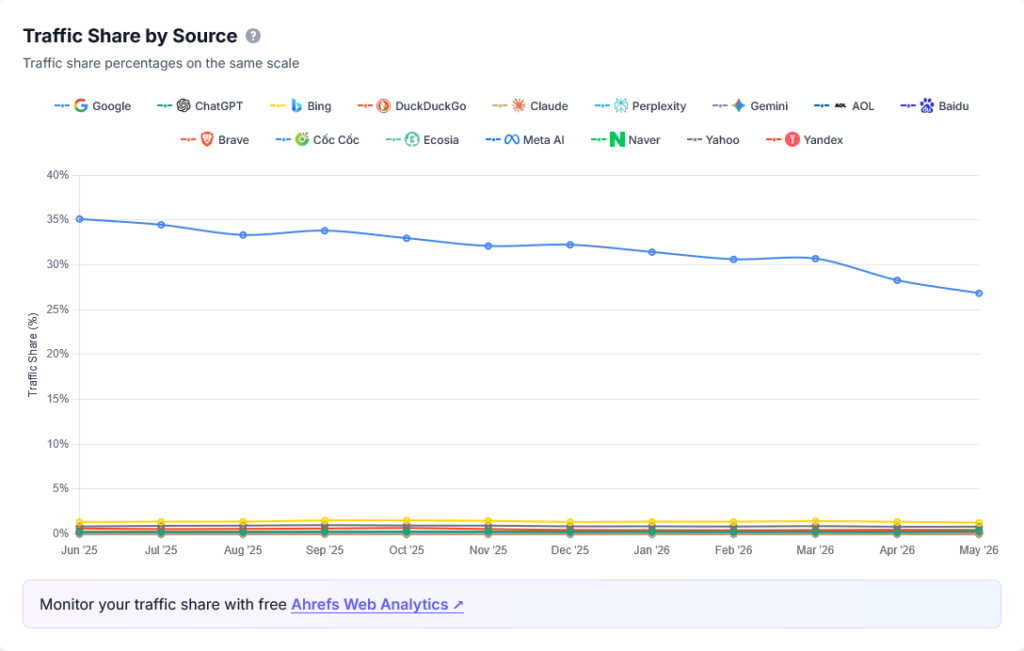
Finally, businesses need to build brand demand beyond Google. SparkToro’s 2026 recommendation is to invest in “zero-click marketing,” which means earning influence and awareness without requiring every interaction to result in a website visit. That might include LinkedIn thought leadership, YouTube content, PR, podcasts, creator partnerships, email newsletters, Reddit engagement, webinars, digital PR, and paid social.
In other words, your audience is still searching. They are just not only searching on Google, and they are not always clicking when they do.
What Marketers Should Measure Instead
Traffic is still useful, but it should not be the only scoreboard.
In a zero-click environment, marketers need a more complete measurement model. That includes branded search growth, direct traffic quality, assisted conversions, lead quality, share of voice, engagement on third-party platforms, email list growth, content-influenced pipeline, and conversion rates from high-intent pages.
This is where data and creativity need to work together. The creative work earns attention. The analytics work tells us whether that attention is moving the business forward.
For many organizations, the most important question will not be, “How much organic traffic did this blog post generate?” It will be, “Did this content help the right audience understand us, trust us, and eventually choose us?”
The Road Ahead
Google is not killing search. But it is changing what search gives back to businesses.
The old search bargain was simple: brands created useful content, Google indexed it, users clicked, and websites earned traffic. The new bargain is more complicated. Brands still need to create useful content, but Google may now deliver the answer directly, with fewer clicks passed along to the source.
That may feel frustrating, but it also creates an opportunity.
The brands that win next will be the ones that stop treating SEO as a traffic channel alone and start treating it as part of a larger influence system. They will build content that can rank, content that can be cited, content that can persuade, and content that can travel across channels. They will pair organic search with paid media, PR, social, email, video, and brand strategy. They will measure what matters, not just what is easiest to count.
At Zozimus, we believe the answer is not to dream smaller because Google is sending fewer clicks. It is to dream bigger, with a smarter strategy.
Zero-click search is here. The brands that adapt will not just survive this shift. They will become the answers their audiences are looking for.
Our SEO services in Boston are measured on conversions and revenue, which is the only KPI that survives a zero-click SERP.

David Wilson
EVP, Digital Marketing and Strategy
David has more than 20 years working in digital marketing, covering in-house for a variety of companies, agencies and running his own digital marketing company. He has worked on Fortune 500 clients in the Pharmaceutical, CPG, Financial Services, and Healthcare verticals.
David brings a passion for proven results to the Zozimus digital marketing team. When asked what he likes about his job, David says that “every day his team has metrics that they are trying to hit for clients. At midnight the scoreboard gets set back to zero and we either hit our goals or we didn’t.”