If you want to know where event activations are headed, skip the trend decks and look at Boston’s 2026 calendar. In the span of four months, the city hosted the 130th Boston Marathon, welcomed millions of visitors for Sail Boston during the nation’s 250th anniversary summer, and served as a FIFA World Cup host city. The calendar got so crowded that Boston Calling, a Memorial Day fixture since 2013, took the entire year off, with organizers citing the strain on hotels, events, and sponsorships.
That density made Boston a stress test. Hundreds of brands activated in the same city, for the same audiences, often on the same weekends. Some approaches clearly earned their budget. Others looked like they were shipped in from 2019. Here’s the breakdown.
What's Working
1. Utility beats spectacle
The activations that drew real crowds in Boston this year solved a problem the audience actually had.
During Marathon weekend, Brooks built a pop-up on Newbury Street with a full recovery area: Normatec compression boots, stretching tables, and yoga mats for runners tapering before the race. It wasn’t flashy. It was useful, and it kept people in the space for 30 minutes instead of 30 seconds.
The same logic showed up around the World Cup. Because Boston’s matches were played 29 miles away at Gillette Stadium, the market functioned as a corridor rather than a single venue, with fans moving between downtown Boston and Foxborough all day. Strategists openly advised brands to own a useful piece of that journey (transit, food, shade, charging) rather than fight for attention at the stadium gates. Massachusetts even put $10 million behind community watch parties in cities like Brockton, Chelsea, and Worcester, spreading the activation footprint far beyond the stadium.
The takeaway: “What does the fan need at this exact moment?” is now a better creative brief than “What will look good on a billboard?”
2. Collectibles people will wait in line for
The runaway hit of the World Cup summer wasn’t a high-tech installation. It was a bracelet. Bank of America’s Fan Bands, free customizable charm bracelets with beads themed to national teams and host city landmarks, drew hours-long lines across all 11 U.S. host cities, including Boston’s FIFA Fan Festival at City Hall Plaza. Some venues had to introduce time slots just to manage demand.
Compare that to the branded stress ball. A collectible works when it’s personal (you build it), scarce (this city, this event, this summer), and shareable (it photographs well on a wrist). Cheap swag checks none of those boxes.
3. Neighborhood takeovers instead of expo booths
Marathon weekend made this shift impossible to miss. The official expo at the Hynes Convention Center is now limited to official sponsors only, while the major running brands have moved their energy to pop-up storefronts along Newbury and Boylston: Tracksmith’s Trackhouse, the Brooks Hyperion House, HOKA’s Light House, rabbit, Runna, and more. One race-week guide put it plainly: the pop-ups now offer all the things that were once part of the main expo.
Tracksmith’s line reportedly snaked down the sidewalk. That’s the model: a temporary flagship in a real neighborhood, programmed with events, beats a 10×10 booth in a convention hall.
4. Partnering with the community that's already there
The smartest Boston activations didn’t import an audience. They borrowed one. Adidas and Nike both ran Marathon-week experiences in partnership with Heartbreak Hill Running Company, the beloved local run shop, hosting shakeout runs and hangouts in Cambridge and the South End. Brooks put Olympians Kara Goucher and Des Linden at the front of its group run.
Dunkin’ did the local-credibility version of this at Sail Boston, building a pop-up shaped like a tall ship and handing out free coffee, Refreshers, and Munchkins, with a spokesperson noting the goal was to tap into the brand’s Boston history. A national brand acting like a hometown brand, at a hometown event, is a hard combination to beat.
5. Emotion-led concepts with a social engine
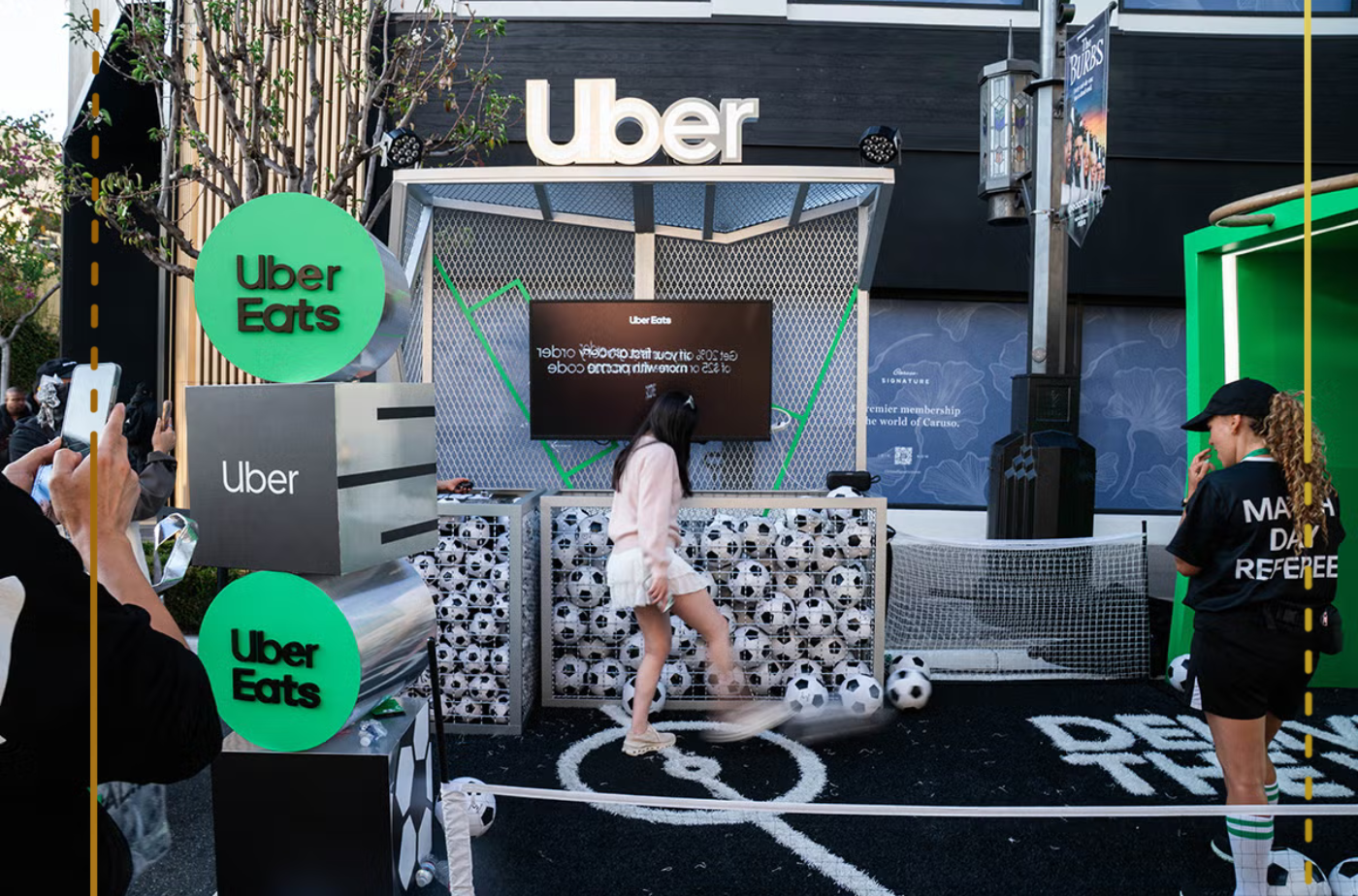
The 2026 activations that traveled online were built around a feeling, not a product feature. Uber’s “Sorry for Your (Team’s) Loss” mobile activation handed branded tissue packs to fans of defeated World Cup teams. Chewy ran a therapy-dog Cuddle Shuttle in Miami. These worked because the concept itself was the content. Nobody needed to be asked to post.
What's Outdated
The step-and-repeat photo wall. A logo backdrop and a ring light is not an experience. Even the photo ops that worked in Boston this year had a concept behind them, like Bank of America’s “Make Way for Ducklings” expo installation with unicorn heads standing in for the ducklings. A photo moment needs a story, or it’s just signage.
Swag with no meaning. Fans at the World Cup fan fests were hunting freebies, but they lined up for hours for one item and walked past tables of the rest. If the giveaway isn’t customizable, event-specific, or genuinely useful, it’s landfill with a logo.
The expo booth as the whole plan. Boston Marathon weekend showed where this ends: the brands driving conversation weren’t inside the convention center. If your entire event presence is a booth and a badge scanner, you’re renting attention in the one place attendees are most defended against it.
Gated engagement. Requiring an app download or a long form before anyone gets the experience kills momentum on-site. The best 2026 activations were friction-free first (free entry, free samples, free bracelet) and captured data through voluntary follow-up, like RSVP-based timed entry.
The one-day stunt with no content plan. A spectacle that isn’t designed to be filmed, clipped, and reposted is a rounding error. Visit Seattle’s World Cup drone scoreboard ran on a repeatable schedule after every match, which turned one production investment into a full tournament of content. That’s the standard now.
The Bottom Line
Boston’s 2026 gauntlet rewarded brands that showed up as hosts rather than advertisers. The winners offered recovery, coffee, shade, a bracelet, a run club, or a laugh after a tough loss, and they built each moment to generate its own content. The losers rented square footage and printed logos.
If you’re planning activations for 2027, when Boston Calling returns and the event calendar normalizes, the brief is simple: be useful, be local, be worth photographing, and give people something they’d wait in line for.