Search Everywhere Intelligence is how Zozimus helps brands see where they stand across search, AI, social, and reputation, and decide what deserves investment.
A brand can look healthy in every monthly report and still be missing when a buyer researches the product that matters most.
That happens because marketing is still measured by channel. SEO tracks rankings. Social tracks engagement. PR tracks coverage. Paid media tracks campaigns. Each report can be accurate, and the overall picture can still be wrong.
Customers do not experience brands in channels. Someone shopping for a new product might spot it on Instagram, watch a demo on YouTube, read reviews, ask ChatGPT to compare alternatives, and then open Google to find a nearby retailer. An executive might read about a company in a trade publication, check it out on LinkedIn, and ask an AI assistant for a shortlist of partners. Before long, personal AI agents may handle part of that research for them.
Every one of those moments shapes whether a brand gets considered. Most organizations measure them separately, if they measure them at all.

Our answer is not another flavor of SEO. It is a different way of understanding how brands get found. We call it Search Everywhere Intelligence (SEI).
What Search Everywhere Intelligence Is
SEI is a framework for understanding how a brand is discovered, evaluated, discussed, and recommended across search engines, AI platforms, social and video, review sites, online communities, and earned media.
It is not about watching more platforms or collecting more metrics. It is about connecting information that usually sits in separate departments so it can answer business questions:
- Where do we have an advantage, and where are we losing ground to competitors?
- Which sources shape how customers and AI systems describe us?
- Is that description accurate?
- Which product categories and buyer needs deserve investment?
- What should we do next?
No SEO report, social dashboard, or AI visibility score can answer those on its own.
Why the Old Scorecard Falls Short
Google gives you impressions, rankings, and clicks. Social platforms give you reach and engagement. Web analytics shows what visitors do on your site.
AI discovery works differently. When someone asks ChatGPT, Gemini, or Perplexity to compare providers, the answer may name several brands, lean on third-party sources, and make a recommendation without sending anyone to a website.
So a company can rank well on Google and rarely appear in AI recommendations. Another can be recommended often because of strong independent coverage, even with modest search traffic. Standard SEO reporting can miss both.
Social and video create the same blind spot. A customer sees a video, searches for the brand a few days later, and converts. The last-click report credits Google, even though the video did the introducing.
None of this makes existing metrics obsolete. It makes them incomplete when you read them one at a time.
The Four Pillars
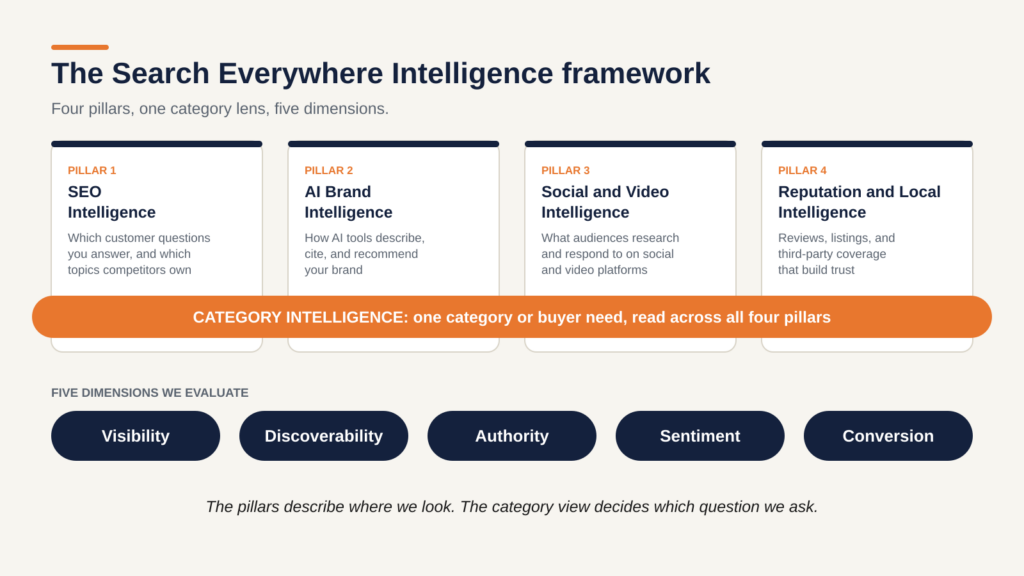
We organize SEI around four pillars. Each looks at a different place where a brand is discovered and judged.
1. SEO Intelligence
Search is still where a lot of customer intent shows up. We look past rankings to ask which customer questions a brand answers well, which topics competitors own, and how search behavior is shifting. Depending on access and scope, that draws on tools such as Google Search Console, GA4, SEMrush, and Ahrefs.
2. AI Brand Intelligence
Does the brand come up when people ask AI tools relevant questions? How often do competitors appear? Which sources get cited, and is the information right? A medical technology company, for example, might rank well on Google and still be absent when an AI assistant compares available solutions. Answering these questions takes structured prompt testing, competitor comparison, and citation analysis, repeated over time. AI answers vary by platform, prompt, and day, so no single test is a verdict. The value is in the patterns that keep recurring.
3. Social and Video Intelligence
People use Instagram, YouTube, TikTok, and LinkedIn to research, not just scroll. Beyond reach and engagement, we look at which topics and formats land and how that connects to search demand. A video that takes off may reveal a customer question that deserves its own page on the website. A LinkedIn debate may surface a concern worth addressing through PR or thought leadership.
4. Reputation and Local Intelligence
Being found is not the same as being trusted. This pillar covers reviews, business listings, Google Business Profiles, industry publications, and earned media. Those sources influence buyers directly, and they may also feed what AI systems say about a brand. That is one reason PR now belongs in the search conversation.
What Brand Averages Hide
A company can be highly visible for its name or its biggest product line and hard to find in the category its growth plan depends on. A brand-level view blends those two positions into one reassuring average. It does not tell a marketing leader where the next dollar belongs.
That is why we add Category Intelligence. It is not a fifth pillar. It is a lens applied across all four, organizing the same evidence around a specific product category, buyer need, or use case. The pillars describe where we look. The category view decides which business question we ask.
It also keeps us from treating every signal as equal. A popular video does not establish purchase intent. A citation does not prove a sale. A visibility gap matters most when it involves a real buyer need in a category the business is equipped and motivated to serve.
Five Dimensions We Use to Read the Evidence
Across the pillars, we evaluate brands on five dimensions:
- Visibility: where and how often the brand appears.
- Discoverability: whether customers can find it when they research a specific need.
- Authority: the credibility attached to the brand, including independent sources.
- Sentiment: how the brand is described, reviewed, and perceived.
- Conversion: whether discovery leads to inquiries, leads, purchases, or appointments.
The combinations are where it gets useful. One brand has strong visibility and weak authority. Another is well liked and hard to find. A third draws plenty of traffic and struggles to turn it into qualified opportunities. Each one calls for a different fix.
A candid note: not all of this can be measured with equal precision. Some outcomes can be tracked directly. Others need controlled testing or directional indicators. A good intelligence framework says plainly which findings are confirmed, which are estimates, and where reliable data does not exist.
Know Who You Are Competing With
Looking at a category changes what “competitor” means. A manufacturer may compete with another supplier for the sale, with a marketplace for the search result, and with a publisher for the answer to a buying question. An AI assistant may cite the publisher while recommending the supplier.
Those are different roles, and they call for different responses. The useful question is which buyer need a source serves, what evidence supports its apparent advantage, and whether closing the gap would advance a commercial priority. That keeps competitive intelligence from becoming a list of everything another brand does well.
Intelligence First, Then Optimization
We keep two jobs separate. Search Everywhere Intelligence measures where a brand stands, diagnoses gaps, and prioritizes opportunities. Search Everywhere Optimization executes and tests the agreed response. Results feed the next round of intelligence.

The separation matters when a team has to decide what to fund. Without it, a visibility observation turns into a content assignment before anyone has asked whether the buyer need is real, the category matters commercially, or the evidence holds up.
To support this, we are developing a Client Intelligence Hub that brings the four pillars into one measurement and decision framework. Dashboard coverage and data integrations will be confirmed as development progresses and each engagement is scoped.
The output we care about is not a bigger dashboard. For each client, our model aims to surface three meaningful priorities a week, where the evidence and scope support that pace. Each recommendation should state:
- The category or buyer need it addresses
- The supporting sources and observation period
- Our confidence level and what evidence is missing
- The commercial rationale
- The proposed action and how success will be measured
A priority might be strengthening content in a category where competitors keep showing up in sampled AI recommendations, fixing business information, producing video that answers buyer questions, or pursuing coverage in an authoritative industry outlet. Category importance, buyer intent, likely value, and effort set the order. A visibility gap alone is not enough.
Over time, documented tests build a record of what appears to work. We judge results against a baseline and account for other plausible causes instead of assuming our work drove every change.
Reporting tells you what happened. Intelligence helps you work out why and decide what to do next.
Getting Ready for AI Agents
Today a customer might ask an AI assistant to research a product. Increasingly, personal agents may monitor options, compare alternatives, or complete authorized transactions on a user’s behalf.
That raises practical questions. Can an automated system accurately understand what your company offers? Are product specs, service descriptions, policies, and location details consistent and easy to access? Is there credible third-party information to support a recommendation?
Reliable measurement of agent-driven discovery is still limited, and the technology is changing fast. The sensible preparation is unglamorous: make sure the information surrounding your brand is accurate, accessible, and useful to both people and machines.
Why This Takes an Integrated Team
One of the biggest barriers to understanding discovery is the org chart. SEO spots content opportunities without knowing how earned media could build authority. PR lands strong coverage without knowing whether AI visibility moved. Social generates real interest that never gets connected to search behavior or conversions. Everyone can be doing excellent work while opportunities fall through the gaps.
At Zozimus, digital strategy, SEO, AI optimization, PR, social, creative, paid media, and analytics work from the same intelligence. An AI visibility gap might call for stronger website content plus targeted PR outreach. A local reputation issue might involve review management, listings, and customer communications. A growing social trend might open the door to search content, creative, and paid amplification.
The advantage is not having those capabilities under one roof. It is using shared intelligence to decide where and how they should work together.
Where to Start
Discovery will keep getting more complicated. Brands do not need to chase every new platform or optimize every possible interaction. They need to know which discovery environments matter, how they perform in them, and where improvement would pay off.
The practical starting point is small: pick one category that matters to the business and one buyer question your current reporting cannot answer. Define the question, establish what the evidence supports, and give execution a clear purpose.
The future of marketing is not about being everywhere. It is about knowing where your brand stands, understanding what drives customer decisions, and acting on the intelligence that matters most.

David Wilson, EVP - Digital
David is a performance marketing executive with 20+ years of experience leading demand generation, ABM, and performance marketing programs for SaaS, enterprise software, and digital experience brands. At Zozimus, he leads a 10 person team across SEO, paid media, programmatic, ABM, and analytics, driving measurable growth for enterprise and Fortune 500 clients. He also helps shape the agency’s AI workflows and innovation strategy.